
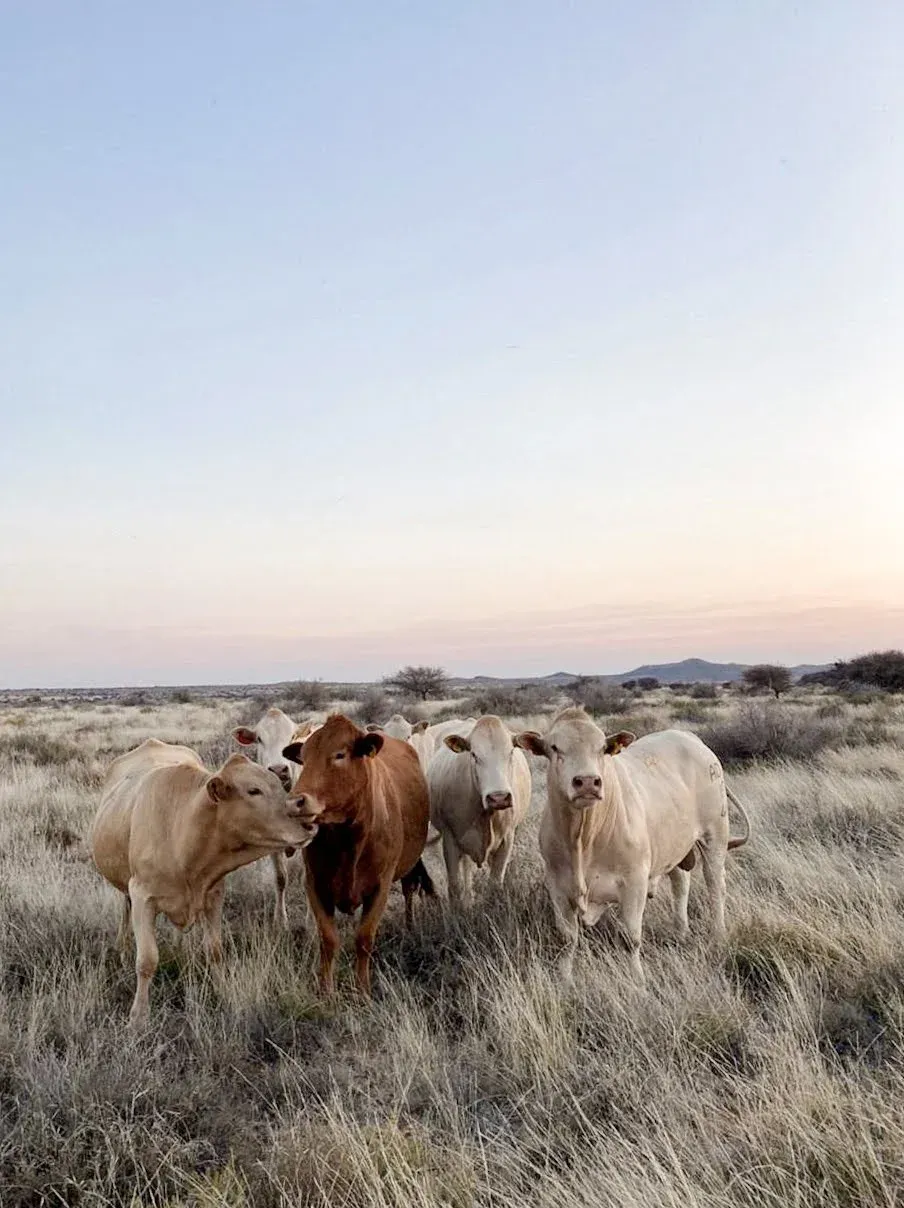
Regenerative cattle farming
Regenerative cattle farming is a holistic approach to livestock management that focuses on restoring soil health, increasing biodiversity and improving the water cycle. Rather than just sustaining the land, it aims to actively improve the veld ecosystem through herded cattle and the economic benefit of increasing the carrying capacity of the veld.
Bob Roux was responsible not only for finding Egerton, but also for introducing the family to the possibilities of regenerative cattle grazing along the lines of Savory principles.
These principles recognise how boundary fences, the loss of large predators and the decline of plains game changed the quality and quantity of Southern Africa’s grasslands. Herds could no longer follow the rain, their impact on the veld was reduced and the remaining scattered animals grazed selectively.
In October 2021, the first six Tuli cattle arrived from Grahamstown. Further breeding cattle followed, and the family selected a mix of small-frame, well-adapted indigenous Tuli, Boran and Nguni breeds. Savory-trained herders Dickson and Duncan Ncube began the daily herding.
In late 2022, Savory-qualified cattle farmer Mike Riddell helped develop a grazing plan of virtual day camps, night camps and weekend camps for strict rotational grazing and rest—the cornerstone of the farm’s regenerative practice.
Egerton continues to develop its organised rotational grazing, supporting better water retention, biodiversity, resilient soils and cattle adapted to the landscape.
Adaptive multi-camp grazing
This is the engine of regenerative farming. Instead of letting cattle roam a large area indefinitely, they are herded tightly and moved frequently between virtual camps.
- The goal Medium-density grazing followed by long recovery periods.
- The benefit Mimic the movement of wild herds, prevent selective overgrazing and allow grass roots to grow deep and sequester carbon.
Soil health and carbon sequestration
In regenerative systems, soil is treated as a living organism. Keeping it covered with living plants or trampled mulch protects it from erosion and extreme temperatures.
- Living soil Microbial life supports the relationship between plant roots and mycorrhizal fungi, helping move atmospheric carbon into the ground.
Biodiversity
Unlike monoculture operations, regenerative farms encourage a variety of life. A mix of grasses, legumes and forbs provides a balanced diet for cattle and a range of rooting depths.
- Integrated wildlife Egerton manages the land to coexist with local game and birdlife, which play roles in pest control and nutrient cycling.
Water cycle restoration
Healthy, carbon-rich soil acts like a sponge. It absorbs rainfall that might otherwise run off compacted or overgrazed land and retains moisture for longer.
- Resilience Improved moisture retention helps the veld remain productive further into the dry season and through periods of drought.